



Programme Coordinator, HAFT Uganda
Rauben Tumuhimbise is a community health advocate and programme coordinator at Health Advocates Frontline-Team. He has led HAFT\'s menstrual health and community diagnostics programmes across Kabarole District and coordinates partnerships with schools, district health offices, and humanitarian organisations operating in western Uganda.
Raised :
$0.00
Goals :
$30,000.00
Progress :
0%
Every Month, 1 in 3 Girls Stays Home
Not because she is sick. Not because she chose to. But because she has nothing safe to use during her period.
Across Uganda — in village schools, refugee settlements, urban slums, and rural homesteads — adolescent girls are improvising with torn cloth, tissue paper, banana fibre, and leaves. The results are predictable: infections, shame, missed lessons, and eventually, dropout.
"I used to hide in the pit latrine for hours on those days. My teacher thought I was lazy. I knew I was just afraid."
— Secondary school student, Kabarole District
This is period poverty. It is not a distant problem. It is happening in classrooms within walking distance of your screen right now.
Our Answer: A Factory That Belongs to the Community
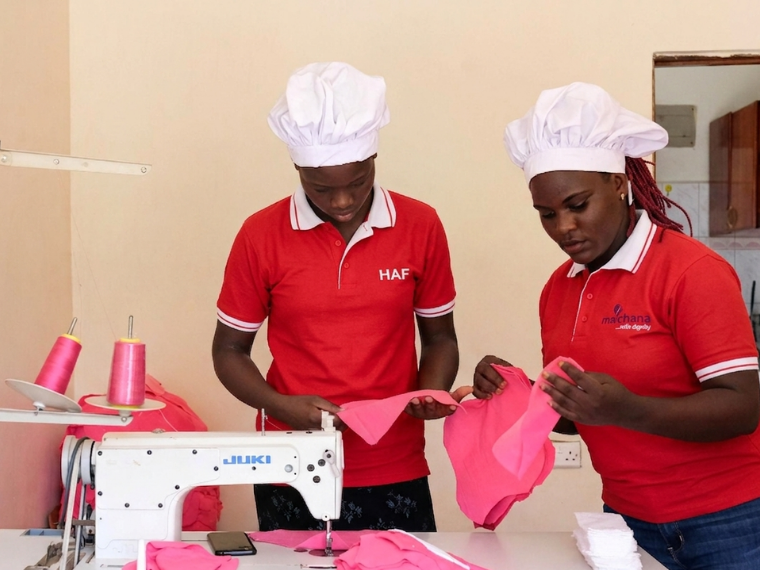
Health Advocates Frontline-Team (HAFT) is raising USD 30,000 to establish a small-scale, community-owned reusable sanitary pad manufacturing enterprise in Uganda.
This is not a one-time distribution drive. It is a permanent, self-sustaining production unit — run by women, for women and girls — that will continue producing long after the initial funding is spent.
What We Will Produce
Each reusable sanitary pad kit is designed to last 12 to 18 months and replaces up to 200 disposable pads annually. Every kit includes:
- Reusable, skin-friendly sanitary pads (absorbent core, waterproof backing)
- Protective underwear
- Washable storage bag
- Menstrual hygiene education booklet
Materials are sourced locally. Production is labour-intensive — which means jobs. Every pad made in this facility is a pad that does not end up in a landfill, and a pad that a girl in a low-income family can actually afford.
Who This Reaches
The enterprise will supply pads directly to:
- Primary and secondary schools — the highest-need group, girls aged 10–18
- Refugee settlements — where commercial products are entirely out of reach
- Women in low-income urban and rural communities
- Government health programs and district health offices
- NGOs and humanitarian organisations running hygiene programs
- Universities and vocational institutions
For the most vulnerable — girls in refugee camps, orphanages, and the poorest rural households — pads will be distributed free of charge through donor-funded allocations built into our pricing model. Those who can pay, subsidise those who cannot.
The Numbers Behind the Need
- Uganda has one of the world's youngest populations — over 55% under age 18
- Approximately 1 in 3 menstruating schoolgirls misses class each month due to lack of sanitary products
- A single girl missing 4–5 days per month loses up to 20% of her school year
- Commercial disposable pads cost UGX 3,000–5,000 per pack — unaffordable on subsistence incomes
- A reusable kit from this enterprise will be priced at less than a third of the annual equivalent disposable cost
How USD 30,000 Gets Spent
| Budget Line | Amount (USD) |
|---|---|
| Sewing machines and production equipment | 8,000 |
| Raw materials (fabric, absorbent cores, waterproof lining) | 6,000 |
| Facility rent and utilities (12 months) | 4,000 |
| Staff salaries and skills training | 5,000 |
| Menstrual health awareness and school outreach | 3,000 |
| Licensing, registration, and administration | 2,000 |
| Contingency reserve | 2,000 |
| Total | 30,000 |
What Happens After Funding
The enterprise is designed to reach financial self-sufficiency within its first year through a combination of:
- Retail sales through pharmacies, drug shops, and open markets
- Bulk institutional contracts with schools and NGOs
- Procurement partnerships with government health programs
- Digital sales via WhatsApp, Facebook, and e-commerce platforms
Surplus revenue is reinvested — into production capacity, into staff wages, and into free distributions for girls who cannot pay anything at all.
Three-Phase Rollout
- Months 1–2 (Setup): Secure facility, procure equipment, recruit and train production team
- Months 3–4 (Pilot): First production batch, quality testing, school awareness launches
- Months 5–12 (Scale): Full production, institutional contracts, regional distribution expansion
The Broader Impact
For Girls
Regular school attendance. Confidence in the classroom. A future that menstruation no longer interrupts.
For Women
Skilled employment in production, quality control, packaging, and distribution. Real wages. Economic independence.
For Communities
Less waste. Better hygiene. Open conversations about menstrual health that reduce stigma and save lives.
For Uganda
A replicable model that can scale to every district — and eventually to regional East African markets.
This Initiative Aligns With
- SDG 5 — Gender Equality
- SDG 3 — Good Health and Well-being
- SDG 4 — Quality Education
- SDG 12 — Responsible Consumption and Production
Support This — and Here Is What Changes
A contribution of any size moves this factory closer to its first day of production. A contribution of the full USD 30,000 establishes it permanently.
Every pad produced here is a girl who stayed in school. Every woman employed here is a family lifted further from poverty. Every reusable kit distributed is hundreds of plastic pads that never reach a landfill.
You are not just donating. You are co-founding something that will outlast all of us.



